

Wisconsin Racing

Every year, around five hundred university teams worldwide receive the same fictional design brief: a manufacturing company wants a prototype Formula-style race car for the non-professional weekend autocross driver. Reproducible at $25,000 per unit. Production run of 1,000.
That brief is the foundation of Formula SAE, the largest student engineering competition in the world, organized by SAE International since 1981. Teams spend the academic year designing, costing, building, and testing a full-size single-seat race car from scratch. In early summer they bring it to Michigan International Speedway — or to one of the international events in Germany, Japan, the UK, Brazil, or Australia — where engineering judges from the automotive and motorsports industries put the cars and the students through static design reviews, cost and business presentations, and dynamic events ranging from a 75-meter acceleration run to a 22-kilometer endurance race.
Then the rulebook drops again. New car. New season. New team. The students who built last year's car are graduating. The students replacing them are starting over.
This is the world Wisconsin Racing lives in.
Need:
Wisconsin Racing is a student-led organization based in UW–Madison's College of Engineering, and one of the largest engineering student groups on campus. The team designs, builds, tests, and races full-size formula-style cars at Formula SAE Michigan, the flagship US event in the series. Students from all majors are welcome — the team has long taken the view that running a program of this scale is itself an engineering-company exercise, and benefits from the broadest possible mix of disciplines.
That breadth shows up in how the team is organized. Specialized sub-teams handle Aerodynamics, Business, Controls, Structures, Electrical, Firmware, Powertrain, Chassis, and Vehicle Dynamics, each focused on a different aspect of the car's design and performance. A separate sub-team interest form lets students pursue personal projects and individual learning goals alongside the main build. The result is a program that produces real engineers doing real engineering: a car that has to pass tech inspection, hold up to twenty-two kilometers of endurance running, and defend its design choices to judges who have built cars at companies like Ferrari, Tesla, and Multimatic.
Solution:
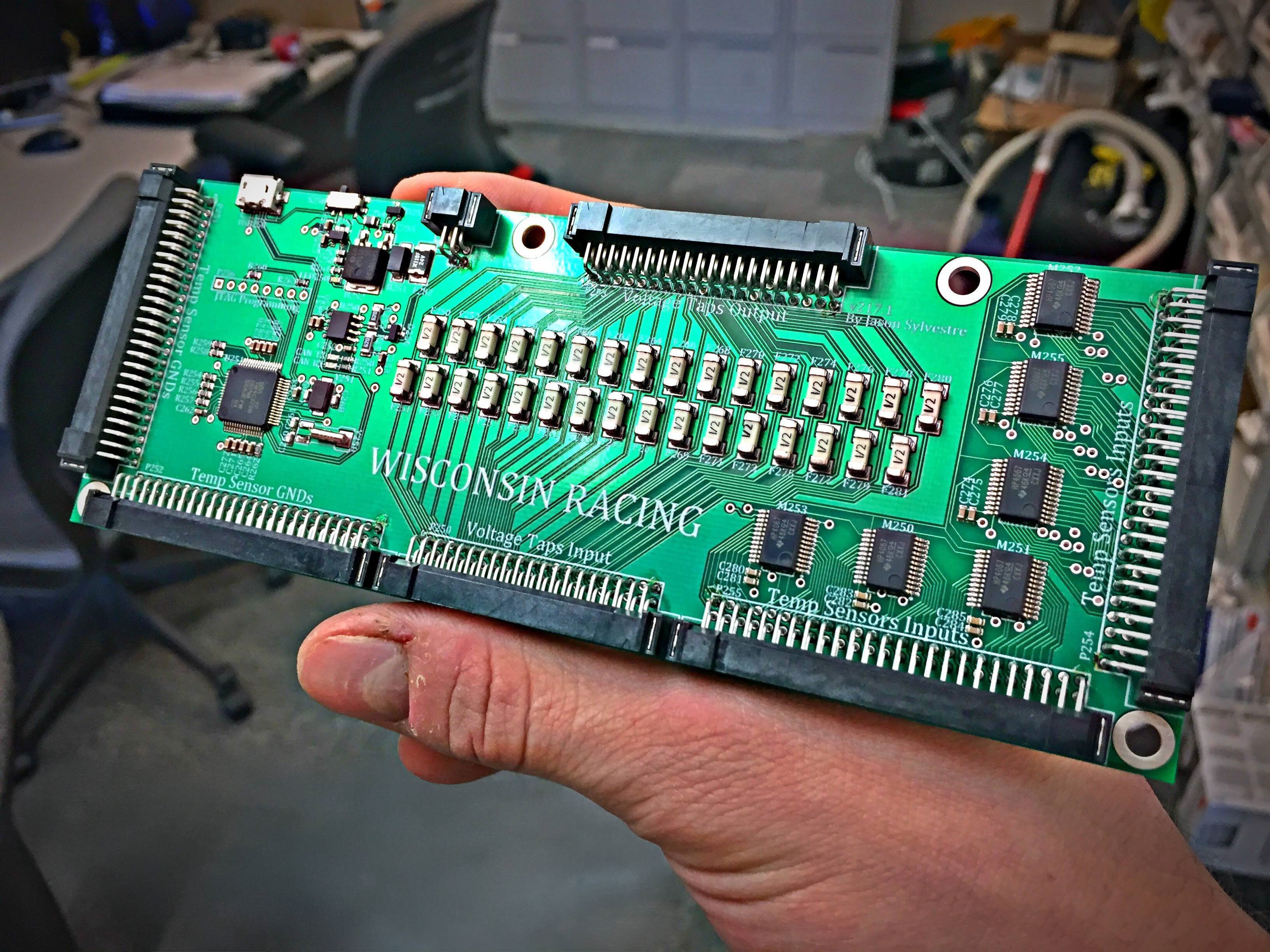
A modern Formula SAE car — particularly on the electric side, which Wisconsin Racing has been competing on since 2017 — is a custom-built EV with a dozen or more mission-critical printed circuit boards, almost all designed in-house by students. There are master and slave boards for the battery management system, reading hundreds of cell voltages and temperatures across the pack. There are motor controllers translating pedal input into per-wheel torque. There is a vehicle control unit running traction control and torque-vectoring algorithms in real time. There is a pre-charge board protecting the high-voltage capacitor bank from inrush damage. There is a shutdown circuit that has to open the tractive system in milliseconds if anything reports a fault. None of this is optional. FSAE Electric rules mandate specific safety circuits, and tech inspection at competition is unforgiving. A bad spin of a board can cost weeks of the build season.
That last sentence is why Wisconsin Racing works with Screaming Circuits. Screaming Circuits has been part of the team's prototyping pipeline since 2017 — going on a decade — turning custom files into functional, populated boards on a timeline compatible with the academic calendar.
When you're designing twelve safety-critical boards across a nine-month build cycle, iteration speed is the constraint. Quick-turn prototype assembly is how a student team fails forward fast enough to actually finish.
Result:
Screaming Circuits sponsors student engineering programs because the engineers who build cars at Wisconsin Racing are the engineers who will be designing products everywhere else in a few years. The skills these students develop — moving from classroom theory to a working board, from a working board to an integrated system, from a system to a car that has to perform in front of judges — are not skills that can be taught in a lecture hall. They have to be built, and broken, and rebuilt.
We're proud to be one of the partners that makes that possible.